
QA & Compliance
Documented Quality Management for Nursery, Children's and Casegoods Programs
Nursery furniture for demanding markets requires more than good woodworking — it requires documented, repeatable control. That discipline runs through every stage from incoming lumber to container loading.
Quality Management System
Six Core Quality-Control Areas
Product Specs & SOPs
A complete product specification and SOP system integrates inspection standards and work instructions into the overall product plan. From sample validation to mass-production handover, every stage has defined checkpoints and quality gates — keeping every workstation aligned and output consistently controllable.
Defect Classification
A structured critical / major / minor defect system with AQL 2.5 sampling at incoming, in-line and final inspection stages. Every defect category is tied to a documented disposition — accept, rework, or scrap.
Moisture Control
In-house kiln drying and moisture metering at multiple checkpoints keep lumber within 8–12% MC — preventing cracking and warping after ocean transit to US, EU or Japan.
Corrective Action Loop
Every rejection triggers a root-cause review: 5-Why or fishbone analysis, corrective action, verification on the next lot, and SOP update where needed. Buyers receive documented CAPA reports on request.
Packaging Consistency
Carton drop tests, vibration-table and compression checks to the relevant ISTA profiles, insert-fit verification, barcode audits and container loading checks are executed to a documented plan on every program — so what shipped last quarter matches what ships this quarter.
Export-Market Compliance
Programs built around ASTM safety standards for cribs and children's furniture, CPSIA lead and phthalate limits, CARB Phase 2 / TSCA Title VI panels, and destination-market labeling requirements.
Inspection Workflow
Inspection Controls from Incoming Materials to Shipment
01
Incoming Materials
Lumber grading, moisture verification, panel emissions certificates, hardware inspection against approved specs.
02
In-Process
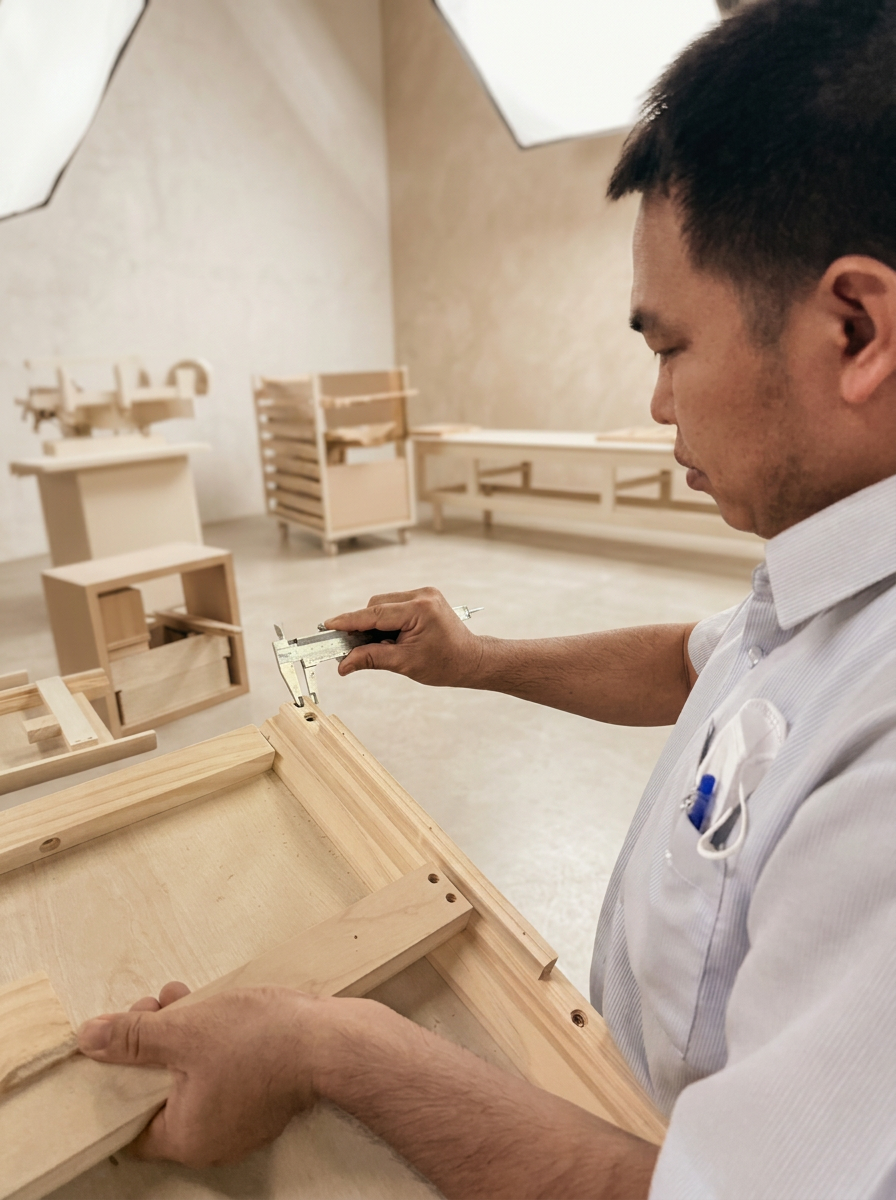
Dimensional checks after machining, joint-fit verification, first-piece approval on every jig change.
03
Finishing
Color match against golden samples, adhesion, coating thickness, dry-film curing verification.
04
Assembly
Sub-assembly fit-check, hardware torque testing, and function testing on drawers and other moving mechanisms, where applicable.
05
Pre-Shipment
AQL 2.5 final inspection, carton drop-test verification, barcode / labeling audit, container loading review.
06
CAPA Loop
Root-cause analysis on any rejection, corrective action deployed, next-lot verification, SOP updated where the change is permanent.
Third-party inspections (SGS, Bureau Veritas, Intertek or your nominated agency) are welcome at any stage of production.
Quality Documentation
A documented quality system, not an experience-based one
Sample, mass production, packaging and shipment are governed by the same documented workflow — designed to reduce shipping errors, hold production consistency and meet retail-channel requirements.
PP Sample Flow
Pre-production samples are built on the actual mass-production line, reviewed against the golden sample, and signed off before any full run is scheduled.
Inspection Checkpoints
Documented inspection gates at incoming materials, in-line machining, finishing, assembly and pre-shipment — each with defined acceptance criteria.
Packaging Validation
Carton, insert and instruction packs validated per SKU: dimensional fit, print proofs, hardware bag audits and barcode / label checks.
Drop-Test Process
In-plant drop, compression and vibration tests aligned with ISTA-style profiles to confirm structural integrity before container release.
AQL 2.5 Inspection
Final inspection to AQL 2.5 (or a buyer-specified plan), with critical / major / minor defect classification and documented disposition.
Weekly Production Reporting
Weekly milestone tracking, output vs. plan reporting and open-issue log shared with the buyer so programs stay predictable end-to-end.
Certifications & Compliance
A compliance-oriented factory built around export markets
We build programs around the documentation, testing and material controls global buyers actually audit against. Third-party test reports and program-level certificates are provided as part of the OEM/ODM package.
ASTM Program Experience
Cribs, dressers and children's casegoods engineered around ASTM F1169 / F406 / F2388 / F1427 stability, structural and safety requirements.
CPSC / CPSIA Workflow
Documented CPSC and CPSIA production workflow — from BOM control to registration cards, tracking labels and destination-market documentation.
CPSIA Lead & Phthalate Testing
Coordinated third-party testing for CPSIA total lead and phthalate limits on paints, coatings and accessible components.
CARB / TSCA Title VI Panels
MDF, plywood and particleboard sourced to CARB Phase 2 / EPA TSCA Title VI formaldehyde limits, with mill certificates on file.
FSC-Ready Programs
FSC-certified material chain available on request for buyers running sustainability or retailer-mandated sourcing programs.
BSCI Social Compliance
Factory operations and worker welfare aligned with BSCI social compliance expectations for global retail supply chains.
C-TPAT Export Readiness
Container security, seal control and shipment documentation practices aligned with US C-TPAT supply-chain security requirements.
Greenguard-Ready Finishing
Low-VOC water-based and NC finishing systems specified to Greenguard Gold-aligned emission targets for nursery and kids' furniture.
Program-level certificates, mill CoCs and third-party test reports available on request.
Standards our OEM/ODM programs are built around: Applicable ASTM standards, CPSC regulations, and CPSIA testing and documentation requirements, subject to product-specific testing, CARB Phase 2 / TSCA Title VI compliant panels sourced per project requirements, Low-VOC / GREENGUARD-class finishing available based on customer specifications, FSC program support available on customer request, BSCI social-compliance audit experience, C-TPAT-aligned export security procedures.